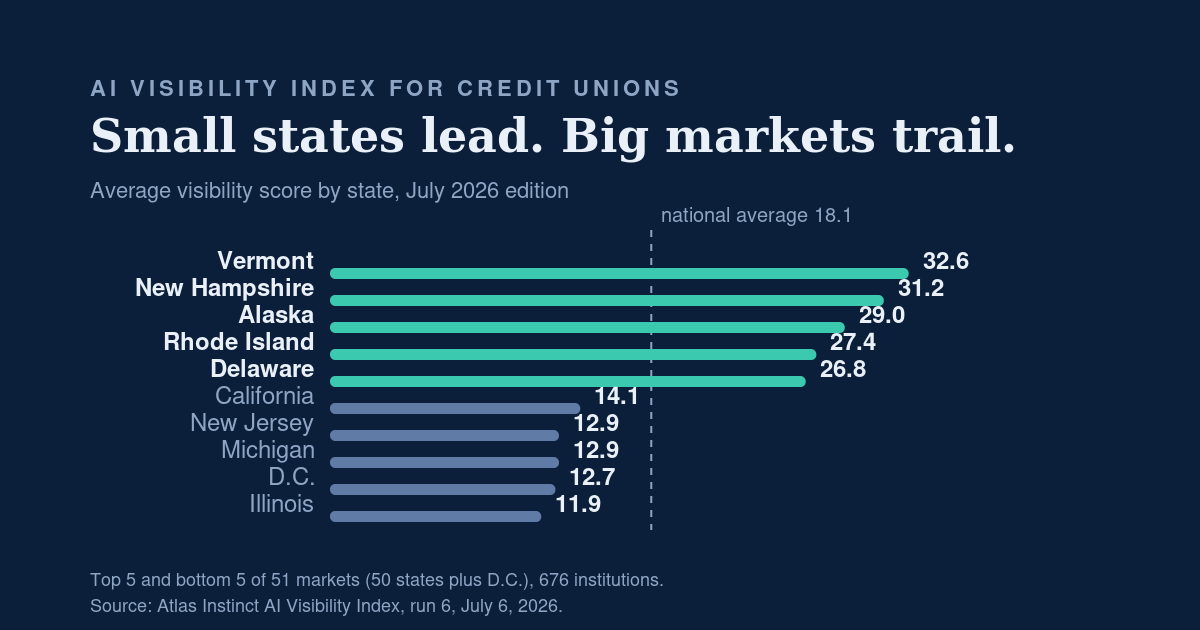
We scanned 676 credit unions across every US state and DC to answer one question: when someone asks an AI model where to bank, does your institution come up. On July 6, 2026, we ran that scan for the first time as a standing index. The national average visibility score came back at 18.1 out of 100. The median is 13.5. Ninety-five percent of the institutions we scored, 95.1% precisely, fall below 50. The average state leader scores 52.5, and institutions appear in an average of 40.6% of the answers where they're relevant at all.
This is the first edition of the Atlas Instinct AI Visibility Index for credit unions. We built it because we kept getting asked the same question by credit union leadership teams: are we actually visible to the AI tools our members are starting to use instead of a search bar. Now there's a number attached to the answer.
The national picture
An average score of 18.1 out of 100 means most credit unions are not part of the conversation when AI models make a recommendation. The gap between the median (13.5) and the average (18.1) tells us the distribution is skewed by a small number of strong performers rather than a uniformly mediocre field. And the gap between the national average and the average state leader (52.5) is the more useful number for most institutions: it shows how much room exists between where you probably are and where the best-performing institution in your own state already sits.
Appearance rate matters as much as score. Across all 676 institutions, the average appearance rate is 40.6%, meaning the typical credit union we tracked shows up less than half the time it's a relevant answer to give.
Featured state: Vermont
Vermont posted the highest average visibility score of any state in this scan, at 32.6, ahead of New Hampshire (31.2), Alaska (29.0), Rhode Island (27.4), and Delaware (26.8). Here's the top six in Vermont:
| Rank | Institution | City | Visibility Score | Appearance Rate |
|---|---|---|---|---|
| 1 | Vermont Federal Credit Union | South Burlington | 72 | 100% |
| 2 | EastRise | Williston | 56 | 100% |
| 3 | North Country | Burlington | 39 | 83% |
| 4 | Green Mountain | South Burlington | 35 | 100% |
| 5 | 802 Credit Union | Barre | 24 | 50% |
| 6 | Heritage Family | Rutland | 23 | 50% |
Small-state credit unions have an obvious advantage: less competition for the answer slot. Fewer institutions means fewer candidates the model has to choose among. But that alone doesn't explain a 72 or a 100% appearance rate. The Vermont leaders are also structurally legible: clear product pages, information organized in a way a model can extract without guessing. Less competition gets you into the running. Structure is what wins once you're there.
The surprising finding: famous but invisible
Size and reputation do not reliably translate into AI visibility, and this scan makes that concrete. Navy Federal Credit Union, the largest credit union in the country by assets, ranks second in its own home state of Virginia, with a visibility score of 39, behind Langley Federal Credit Union at 41. PenFed ranks 11th in Virginia, scoring 7 with a 17% appearance rate.
State Employees' Credit Union of North Carolina, the second largest credit union in the United States by assets, ranks 15th in its own state. Its visibility score is 3, with a 17% appearance rate. Coastal Credit Union (47) and Truliant (46) lead North Carolina instead, neither close to SECU in size.
Brand equity built over decades, offline, does not automatically transfer to AI visibility. That's a distinct system with its own rules, and this scan shows institutions large and small getting caught out by the gap.
What separates the leaders
This scan tells us who AI recommends. It doesn't tell us why on its own, so we pair it with our audit benchmark, a separate instrument that looks at what a site gives AI to work with in the first place. As of July 2026, across 424 evaluations covering 185 unique sites, we've found structured data implementation to be the single most common recommended fix, appearing in 85 of those audits, more than any other action. Accessibility is the weakest category overall, averaging 51 out of 100, and it fails outright (scoring under 40) on 43% of evaluations, 183 of 424.
These are two different measurements. The visibility index measures outcomes: whether AI actually recommends you. The audit benchmark measures inputs: whether your site gives AI anything usable to work with. We don't collapse the two into one number, but the pattern between them is consistent with what we see across engagements: institutions with legible, well-structured, accessible sites tend to show up more often and rank higher when they do.
Methodology
This is scan six of our ongoing tracking, published July 6, 2026, and the first we're releasing as a standing public index. The scan runs on Atlas Instinct's proprietary AI visibility audit platform. We asked an AI model with live web search (gpt-4o class) for credit union recommendations across all 50 states plus DC, using a consistent prompt pattern per state. The visibility score blends how often an institution appears across those prompts and how prominently it's positioned when it does. Appearance rate is a straight percentage of relevant prompts where the institution showed up at all.
This is the first edition, so there's no month-over-month movement to report yet. Starting with the next edition, we'll track which institutions moved up, which moved down, and by how much. Every scan runs against the same model class and the same question format so the comparison holds over time. We'll note if either changes.
Kevin Farley, the founder of Atlas Instinct, wrote up his own read on this launch, including the finding that surprised him most: I Ranked Credit Unions by AI Visibility in Every State.
Get your full report
The national numbers and Vermont's leaders are the free layer. Full 50-state tables, institution-level scores for all 676 credit unions, and category breakdowns are available on request. Request your state and we'll send you the full picture, including where your closest competitors land.
Start a conversation with our team, or request your snapshot to see exactly where your credit union stands today.